Engineering · Code
SCDF Cat Ladder and Solar Roof Access Singapore
When a cat ladder is acceptable for rooftop solar PV access in Singapore, and when the SCDF Fire Code 2023 requires more — clauses to check and a practical decision tree for owners and installers.
· By Ezzogenics
Why this matters now
Singapore is racing toward its 2 GWp solar deployment target by 2030 under the Green Plan 2030. Almost every commercial roof, JTC industrial roof, HDB block-top, and even private warehouse over the next five years will host solar PV modules. Yet a surprising number of project teams discover, late in the design phase, that the building's existing rooftop access — typically a single cat ladder — does not satisfy the SCDF Fire Code 2023 Clause 10.2 for roof-mounted solar PV.
The cost consequence is meaningful: a retrofitted external exit staircase on an existing warehouse can cost S$ 60,000–150,000, while a new compliant cat ladder costs S$ 2,000–8,000. Knowing exactly when a cat ladder satisfies SCDF — and when it doesn't — is therefore a financial as much as a safety question.
This blog walks through:
- The legal framework: Fire Safety Act → Fire Code 2023 → cat-ladder rules
- Clause 2.2.11 — when a cat ladder is allowed as the second exit
- Clause 10.2 — the solar PV-specific access rules
- Clause 9.1.1d — additional rules for PG I (residential) buildings with PV
- The 2015 Fire Code amendment that changed everything for solar
- SCDF storey-shelter cat-ladder rules (a special case)
- A practical decision tree for solar PV installers
1. The legal framework
The chain of authority for any cat-ladder requirement in Singapore is:
Fire Safety Act (Cap. 109A)
        ↓
Fire Safety (Building Fire Safety) Regulations 2023
        ↓
Fire Code 2023 (Code of Practice for Fire Precautions in Buildings)
        ↓
Specific Clauses — Chapter 2 (Means of Escape) and Chapter 10 (Special Installations)
The Fire Safety Act empowers the SCDF Commissioner to issue the Fire Code, which has the force of regulation. Cat-ladder requirements live in two main places:
- Chapter 2 — Means of Escape — Clause 2.2.11 (number of exit staircases / cat ladders per storey)
- Chapter 10 — Requirements for Special Installations — Clause 10.2 (Solar PV)
Both are enforceable as part of the building plan submission to the Commissioner of Civil Defence, and non-compliance is grounds for refusal of Fire Safety Certificate (FSC) and Temporary Fire Permit (TFP).
2. The default rule: every storey needs ≥ 2 exits — but rooftops can use a cat ladder
Per Fire Code 2023 Clause 2.2.11:
"There shall be at least two independent exit staircases or other exits from every storey of a building, unless otherwise permitted under other subsequent provisions of the Code."
This is the baseline. But the same clause carves out two important exceptions for non-habitable roofs (i.e. roof spaces not normally occupied):
Exception (a) — One staircase + one-way travel within limit:
"For non-habitable roof that is able to comply with one-way travel distance, at least one exit staircase shall be provided. The travel distances for roof areas which are open-to-sky shall be based on the requirements for sprinkler-protected buildings."
Exception (b) — One staircase + one cat/ship ladder (when one-way travel can't be met):
"For non-habitable roof that is unable to comply with one-way travel distance to the exit staircase, an additional cat/ship ladder adequately separated in accordance with Cl.2.3.12 and leading to the circulation area of the floor below shall be provided. All access hatches, if provided, shall be readily accessible from the roof. Access hatch opening shall have a minimum clear width of 1m in diameter."
What this means in practice:
| Roof situation | Minimum access | Cat ladder OK as 2nd exit? |
|---|---|---|
| Non-habitable roof, small footprint, ≤ 30 m one-way travel | 1 staircase | Not required |
| Non-habitable roof, large, exceeds one-way travel | 1 staircase + 1 cat/ship ladder | YES |
| Habitable roof (rooftop garden, function space) | 2 staircases | NO — 2 staircases mandatory |
| Storey shelter rescue hatch | Cat ladder mandatory | YES (only access permitted) |
Cl. 2.3.12 (referenced above) requires the two exits to be adequately separated — typically diagonally opposite ends of the roof, at distance ≥ ½ × the diagonal of the area served.
Access hatch dimensions are explicit: ≥ 1 m clear opening. SCDF tightened this from the previous 700 mm to allow firefighters with breathing apparatus and equipment to pass through.
3. The solar PV-specific rule — Clause 10.2
This is the clause every solar developer must know. Clause 10.2 of the Fire Code 2023 governs roof-mounted PV installations (SCDF Cl. 10.2).
10.2(b) Means of Access
"For access to PV installations on the roof (excluding non-PV areas), at least one exit staircase shall be provided. Where the area is large and one-way travel distance to the exit cannot be met, an additional cat ladder or ship ladder adequately separated from the exit staircase, in accordance with Cl.2.2.11 and leading to the circulation area of the floor below shall be provided…"
In plain language:
| Building configuration | Required access |
|---|---|
| Single-storey building, roof height ≤ 12 m | Portable sturdy ladder OR cat/ship ladder (no staircase needed) |
| Inaccessible pitched roof up to 24 m from grade | Portable sturdy ladder OR cat/ship ladder |
| Single-storey + fire engine access road serving roof ≤ 12 m | No PV access ladder required (firefighters use turntable from below) |
| Inaccessible pitched roof 12–24 m + fire engine accessway | No PV access ladder required |
| External / open-sided overhead bridge / linkway, clear width ≤ 6 m, height ≤ 12 m, no commercial activity | Exempted entirely |
| Multi-storey building, large flat roof | 1 exit staircase + 1 cat ladder if travel distance fails one-way limit |
| Existing buildings (PV plans submitted ≤ 16 June 2016) | Cat/ship ladder only (grandfathered) |
10.2(c) PV Array Geometry — interacts with cat ladder placement
Clause 10.2 also caps the PV array footprint:
| Item | Limit |
|---|---|
| Maximum PV array dimension | 60 × 40 m (PG II–VIII); 40 × 40 m sub-array for high hazard |
| Clearance around access hatch / staircase exit door | 3 m all around |
| Perimeter aisle, no parapet ≥ 900 mm | ≥ 2.5 m clear |
| Distance from any PV module to nearest access aisle | ≤ 20 m |
The cat ladder, where used, lands inside that 3 m clear zone — not in the middle of the PV field. It must be unobstructed for firefighter access during a panel fire.
10.2(d) Detection & Suppression Triggers
Clause 10.2(d) lists conditions under which the building must be upgraded with automatic fire alarm system (SS 645) and PV modules elevated ≥ 200 mm above the finished roof level — typically:
- PV installation on roof of PG VIII building > 8 m (vehicle access level to roof)
- PV installation on high-hazard occupancies
If you are adding solar to a warehouse roof at ~10 m height, this clause is the one that drives the most CAPEX — full alarm + cat-ladder access + firefighter exit signage.
4. Why the rules tightened in 2015
Before March 2015, most rooftop solar installs in Singapore used a single existing cat ladder for access. After a series of overseas rooftop PV fires — and the realisation that a single narrow cat ladder cannot accommodate firefighters carrying hose reels and breathing apparatus — SCDF issued a circular requiring two exit staircases for new solar PV roofs in most cases (Straits Times, March 2015).
The rationale, in SCDF's own words at the time:
"Currently, rooftop access of many buildings is via cat ladders, which are usually narrow and cannot accommodate the transport of equipment… existing ladders to rooftops are for maintenance works." — Asst Commissioner Christopher Tan, SCDF Director of Fire Safety & Shelter
The 2015 circular was later codified into the Fire Code 2018 and 2023 as Clause 10.2. The current rule is therefore a post-2015 policy that grandfathers older buildings (plans before 16 June 2016) but applies in full to any new submission or PV addition.
5. Storey-shelter cat ladders — the special case
Clause 2.11 of the SCDF Technical Requirements for Storey Shelters 2021 mandates a cat ladder for every rescue hatch, with very specific structural requirements (SCDF Cl. 2.11):
| Requirement | Spec |
|---|---|
| Material | Stainless steel or aluminium or equivalent (mild steel not permitted) |
| Mounting connection | Designed for shock load ≥ 12.5 g in all directions |
| Rescue hatch clear opening | 700 × 700 mm |
| Vertical position | Aligned with hatch above; offset from hatch above by ≥ 1400 mm for floor of cell below |
| Hatch material | Airtight sealed galvanised steel, fire-rated |
The 12.5 g shock load is the most onerous design action in the Singapore building canon for cat ladders — for an 80 kg ladder this translates to ~10 kN shock at every anchor in every direction. It demands ETA Option 1 chemical anchors with seismic C2 rating (e.g. Hilti HIT-RE 500 V4 or Fischer FIS EM Plus + A4 stainless rod, hef ≥ 110 mm).
6. Decision tree — do I need a cat ladder for my solar PV install?
Q1: Are you adding PV modules to a roof?
        │
        ├── No  →  Apply normal Cl. 2.2.11 rules
        │
        └── Yes →  Q2

Q2: Is the building a single-storey with roof height ≤ 12 m?
        │
        ├── Yes →  Q3: Is there a fire-engine access road serving the roof?
        │              ├── Yes  → No ladder required (Cl. 10.2(b)(2)(a))
        │              └── No   → Portable sturdy or cat/ship ladder OK
        │
        └── No  →  Q4

Q4: Is it an inaccessible pitched roof up to 24 m from grade?
        │
        ├── Yes →  Q5: Is there a fire-engine accessway serving 12–24 m height?
        │              ├── Yes → No ladder required
        │              └── No  → Portable sturdy or cat/ship ladder OK
        │
        └── No  →  Q6

Q6: Is the roof footprint such that one-way travel distance
    to the single exit staircase exceeds the Cl. 2.2 limit?
        │
        ├── No  →  1 exit staircase only — no cat ladder required
        │
        └── Yes →  1 staircase + 1 additional cat/ship ladder
                   (separation per Cl. 2.3.12, hatch ≥ 1 m clear)

Q7: Does the building fall under PG I (residential)?
        │
        └── Yes →  Apply Cl. 9.1.1d additional requirements

Q8: Is the building > 8 m to roof, PG VIII or high-hazard?
        │
        └── Yes →  Add SS 645 alarm system + 200 mm PV elevation
                   per Cl. 10.2(d)
7. What a compliant submission looks like
For a typical JTC industrial warehouse roof at 10 m height with 2,500 m² of PV modules, the SCDF Fire Safety submission should include:
| Document | Content |
|---|---|
| Cover plan | Building footprint, roof access points, fire engine accessway, PV array boundaries |
| Roof plan | All exit staircases, cat ladders, hatches, marked with travel distances |
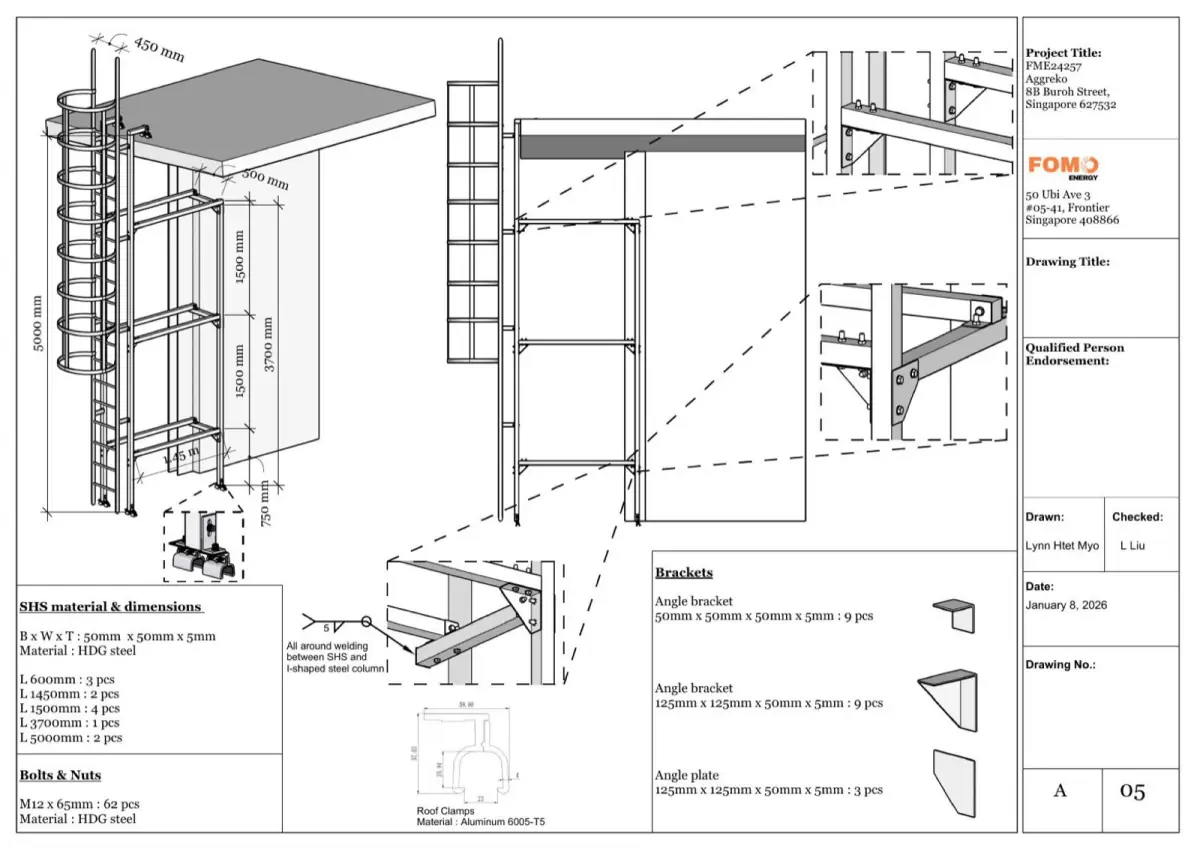
| Cat ladder GA + sections | Front + side elevation, dimensions, materials, bracket details |
| PE-endorsed structural calc | Loads per EC0 / EC1, anchor design per EN 1992-4 |
| PV array layout | Sub-array sizes ≤ 60 × 40 m, 3 m clearance around hatches/exits, ≤ 20 m to access aisle |
| Fire engine accessway plan | Position, length, hardstand specs |
| Alarm system specs | If Cl. 10.2(d) triggered — SS 645 compliant, with rooftop detectors |
| Site simplified plan | A1-size at hatch / exit, height 1.5–2 m above floor (Cl. 10.2 §3.4.3) |
| Maintenance access plan | Workplace Safety & Health Act compliance — fall-arrest anchor points, edge protection |
8. Common mistakes that delay solar PV approvals
After many years of solar PV submissions in Singapore, the top eight reasons for SCDF feedback are:
- Travel distance not calculated — the QP simply assumes one-way travel is OK without showing the math
- Cat ladder hatch < 1 m clear — old installations had 700 mm hatches; SCDF now requires 1 m
- PV modules within 3 m of the exit door / hatch — Cl. 10.2 requires 3 m clearance
- Cat ladder lands in the middle of the PV array instead of at the building edge
- No simplified site plan at the hatch — required to show layout + circuit diagram
- Two exits not "adequately separated" — usually too close together; should be diagonally opposite
- PG I residential building treated as PG II — different rule set applies (Cl. 9.1.1d)
- Existing pre-2016 building incorrectly assumed grandfathered — only valid if PV plan was submitted before 16 June 2016
9. Owner / installer checklist
| ☐ | Item | Reference |
|---|---|---|
| ☐ | Confirm Purpose Group of building (PG I–VIII) | Fire Code Cl. 1.4 |
| ☐ | Confirm habitable height (vehicle access level → highest occupied floor) | Cl. 1.4 |
| ☐ | Map roof type: non-habitable flat / pitched / habitable | Cl. 2.2.11 |
| ☐ | Calculate roof one-way travel distance to nearest exit | Cl. 2.2 |
| ☐ | Determine access requirement: 0 / 1 portable / 1 cat / 1 staircase + 1 cat / 2 staircases | Cl. 10.2(b) |
| ☐ | If cat ladder required: design to EN ISO 14122-4 with PE endorsement | Building Control Act §5A |
| ☐ | Hatch ≥ 1 m clear | Cl. 10.2(b) |
| ☐ | Cat ladder lands inside 3 m clear zone | Cl. 10.2(c) |
| ☐ | Sub-array ≤ 60 × 40 m (or ≤ 40 × 40 m for high hazard) | Cl. 10.2(c) |
| ☐ | Perimeter aisle ≥ 2.5 m if no parapet ≥ 900 mm | Cl. 10.2(c) |
| ☐ | All PV ≤ 20 m from nearest access aisle | Cl. 10.2(c) |
| ☐ | If Cl. 10.2(d) triggered: SS 645 alarm + 200 mm PV elevation | Cl. 10.2(d) |
| ☐ | Simplified site plan + circuit diagram displayed at access | Cl. 10.2 §3.4.3 |
| ☐ | Workplace Safety & Health risk assessment for installation works | WSH Act |
| ☐ | If storey shelter cat ladder: SS or aluminium + 12.5 g shock anchorage | SCDF SS Cl. 2.11 |
| ☐ | LEW endorsement of PV electrical scheme | Singapore Solar PV Handbook |
10. Bottom line
For most Singapore buildings adding rooftop solar PV:
- Single-storey ≤ 12 m, with fire engine road: no ladder required — fire trucks reach the roof directly.
- Single-storey ≤ 12 m, no fire engine road: portable sturdy ladder OR cat ladder is sufficient.
- Multi-storey large flat roof: typically 1 exit staircase + 1 cat ladder (the cat-ladder-as-second-exit rule under Cl. 2.2.11 + Cl. 10.2(b)).
- Pre-2016 plan-stamped buildings: grandfathered with cat ladder only, no staircase upgrade required.
- Storey shelter rescue hatch: cat ladder mandatory, SS or aluminium, 12.5 g shock load anchorage.
The cat ladder is back in fashion for rooftop solar precisely because Clauses 2.2.11 and 10.2 explicitly permit it as the second exit on non-habitable roofs. But the design must satisfy EN ISO 14122-4 for geometry, EN 1992-4 for anchorage, and (if applicable) the 12.5 g shock requirement of the SCDF storey-shelter regime.
The cost difference between a compliant cat-ladder install (~ S$ 5,000) and a retrofitted exit staircase (~ S$ 100,000+) is usually decisive for the project economics. Specifying the right cat ladder, at the right place on the roof, with the right SCDF clause cited on the drawing, is what gets the FSC issued without comments.
References cited inline. Authority hierarchy: Fire Safety Act (Cap. 109A) → Fire Code 2023 → Clauses 2.2.11, 9.1.1d, 10.2 → SCDF Submission Requirements for Solar PV Systems on Roof. Companion to the 18 m cat-ladder design blog and the EN10025 Steel Grades workbook.