Glass · Customer Guide
Singapore Glass Selection Guide
A plain-English buyers’ guide to choosing the right glass for windows, doors, railings, balustrades, shopfronts and façades in Singapore — covering laminated, IGU/DGU, Low-E, tempered and heat-soaked glass.
· By Ezzogenics
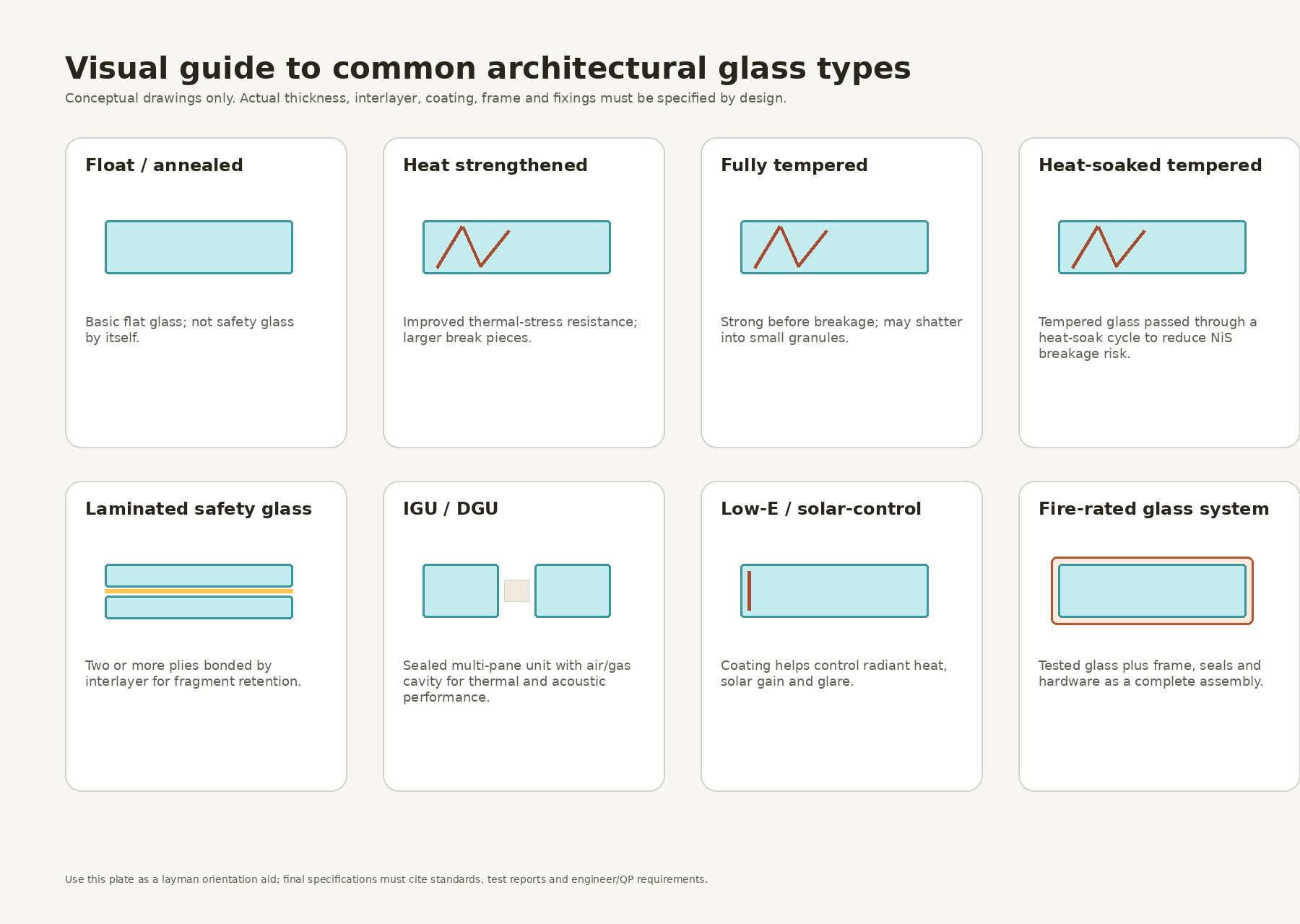
Singapore buildings need glass that does more than look good. The right glass can reduce heat, improve daylight comfort, lower glare, protect interiors from UV exposure, improve safety after breakage and support compliance for windows, doors, barriers and façade systems.
This guide explains common glass types in plain English: IGU, DGU, laminated glass, heat strengthened glass, tempered glass, heat-soaked glass, float glass, low-E glass and fire-rated glass systems. It is written for owners, MCSTs, contractors, designers and project teams who want to choose glass confidently before asking suppliers for quotations.
Need glass for a window, railing, door, shopfront, partition or façade? Send the location, approximate panel size, photos, height from floor level and the problem you want to solve. We can help you shortlist the correct glass direction before you compare supplier quotations.
Get a glass recommendation before you buy
SEO summary: Request a Singapore glass recommendation for laminated glass, IGU, DGU, low-E glass, tempered glass, heat-soaked glass, glass railings, window glass, glass doors and façade glazing before confirming a quotation.
Glass quotations can look similar even when the performance is very different. Before you approve a price, ask for the glass build-up, thickness, interlayer, coating, cavity, safety role and test documents. A small difference in specification can change heat reduction, impact safety, acoustic comfort and post-breakage behaviour.
For a faster recommendation, prepare these details:
- Project location: HDB, condo, landed home, shop, office, school, industrial building or public area.
- Glass use: window, balcony barrier, staircase railing, void edge, door, partition, canopy, roof, shopfront or façade.
- Main concern: heat, glare, safety, falling glass, noise, privacy, fire rating, impact risk or code compliance.
- Basic photos: inside view, outside view, frame detail and surrounding area.
- Approximate dimensions and whether the glass is above head height or beside a drop.
Call to action: Share these details before ordering. It is easier to choose the right glass before fabrication than to correct the wrong glass after installation.
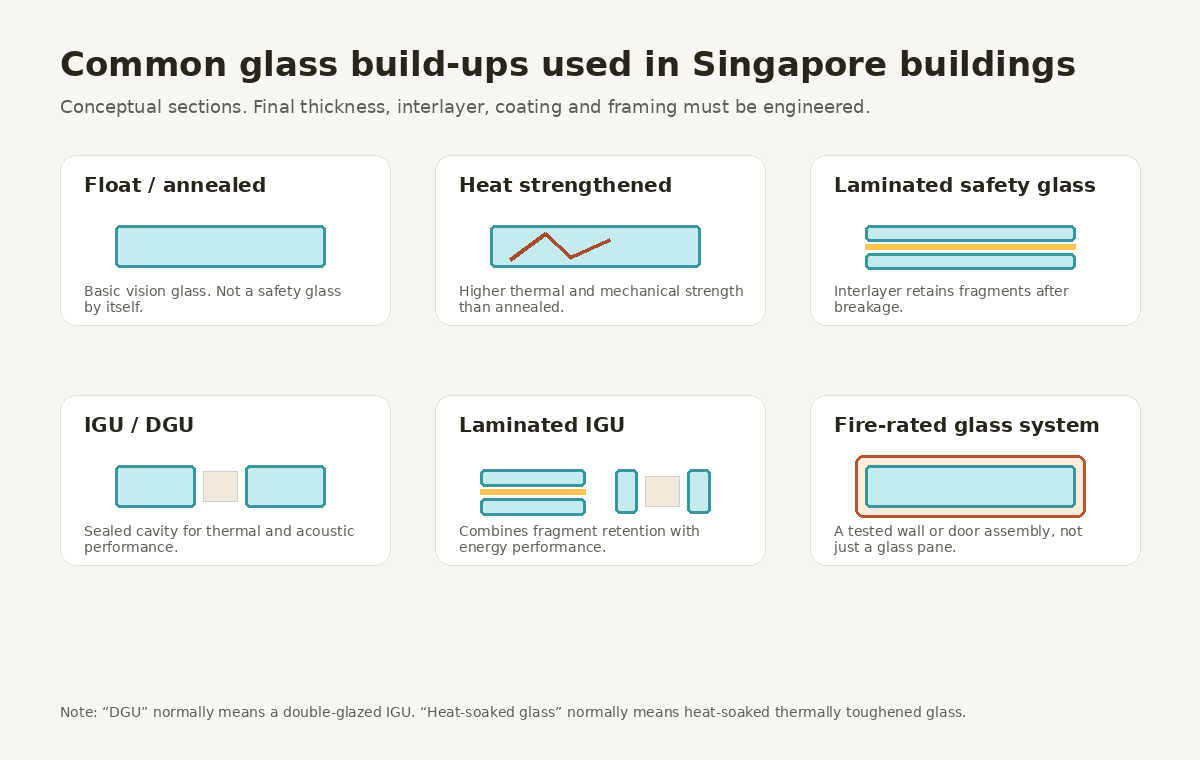
Quick guide: which glass should you ask for?
SEO summary: Use this Singapore glass selection guide to compare laminated glass, tempered glass, IGU, DGU, low-E glass, heat-soaked glass and safety glazing for windows, glass doors, railings, balconies, façades and shopfronts.
| Application | Recommended starting point | Why it is commonly selected |
|---|---|---|
| Home windows | Float, heat strengthened, laminated, or IGU depending on height, exposure and acoustic needs | Balances cost, view, weather performance and safety. |
| Large windows or façade panels | Heat strengthened, laminated, laminated IGU, or heat-soaked tempered where suitable | Manages wind, thermal stress, heat gain and falling-fragment risk. |
| Internal glass partitions | Laminated or tempered laminated glass | Improves impact safety and post-breakage retention. |
| Glass doors in public areas | Safety glass with visible manifestation bands | Reduces human-impact risk and improves visibility for users. |
| Balcony, staircase and void-edge barriers | Laminated safety glass | The interlayer helps hold fragments together after breakage. BCA guidance for glass barriers points to laminated glass and SS 341 compliance. |
| Solar-facing rooms | Low-E glass, tinted/solar-control glass, or solar-control IGU | Reduces solar heat gain, glare and UV exposure while preserving daylight. |
| Fire compartment walls or doors | Fire-rated glass system, not ordinary tempered or laminated glass | Fire resistance depends on the tested glass, frame, beads, seals and hardware as one assembly. |
Visual reference: how the glass types look
SEO summary: These glass diagrams and reference photos help customers understand the visible difference between laminated glass, IGU/DGU, solar-control glass, tempered glass breakage and glass barriers before specifying a project.
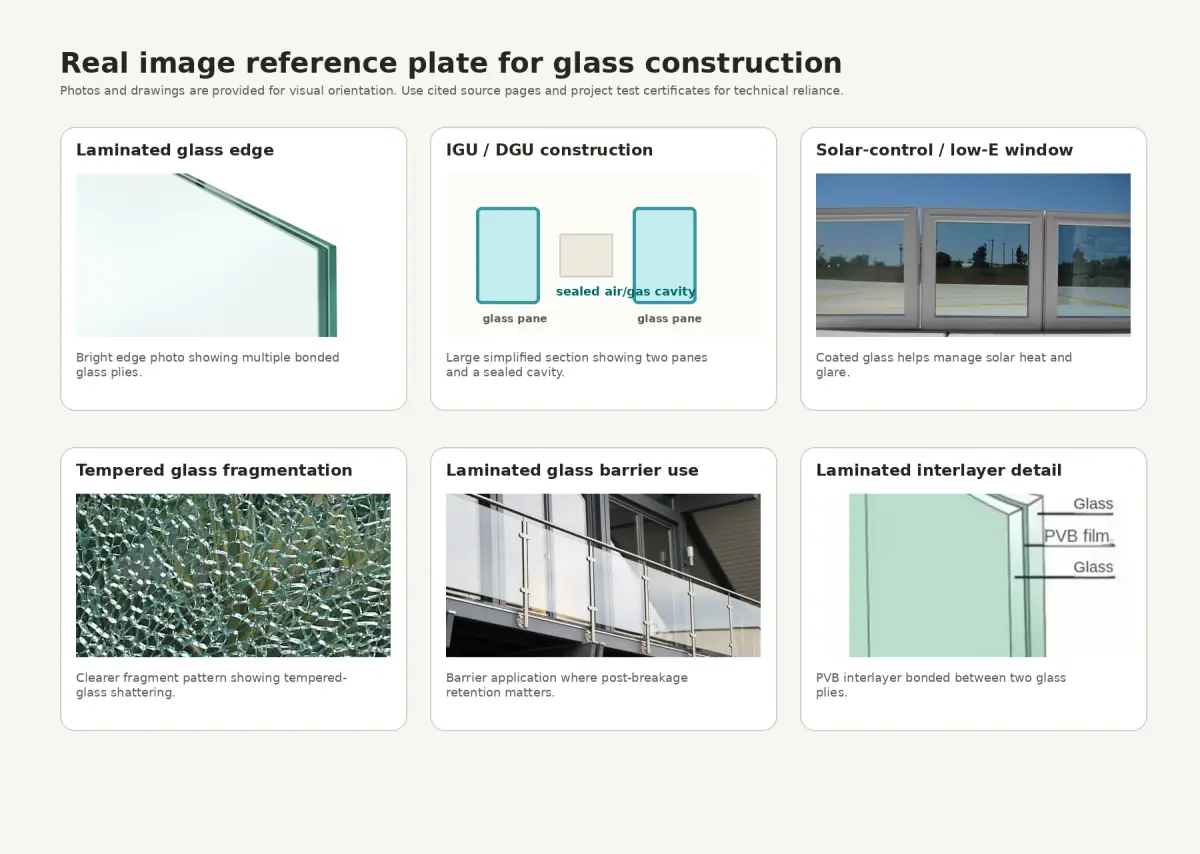
The technical difference between common glass types
SEO summary: The technical difference between float glass, heat strengthened glass, tempered glass, heat-soaked glass, laminated glass and IGU/DGU is the manufacturing process, the way each glass resists stress and the way it behaves after breakage.
Float glass
Float glass is the base flat glass used to make many other products. It is produced by floating molten glass on molten tin to create a flat, smooth sheet. By itself, ordinary float glass is not normally treated as safety glass because it can break into large sharp pieces.
Use float glass where the risk is low, the pane is not acting as a barrier, and the design does not require safety glazing, solar control or special acoustic performance.
Heat strengthened glass
Heat strengthened glass is reheated and cooled faster than ordinary annealed glass, but not as aggressively as fully tempered glass. This improves resistance to thermal stress and some mechanical stress.
It is often used where glass needs better strength than annealed glass but where full tempering is not ideal. It does not usually break into small granules like fully tempered glass, so laminated heat strengthened glass is often preferred where post-breakage retention matters.
Fully tempered glass
Fully tempered glass is heated and rapidly cooled to create surface compression. This makes it much stronger than ordinary float glass before breakage.
The trade-off is breakage behaviour. When fully tempered glass fails, it can shatter suddenly into many small fragments. In some cases, spontaneous breakage can occur, including from nickel sulphide inclusions, edge damage, installation stress, thermal stress or impact. Heat soaking can reduce the risk of nickel sulphide related spontaneous breakage, but it does not remove every breakage risk.
Heat-soaked tempered glass
Heat-soaked tempered glass is tempered glass that has gone through a controlled heat-soak process to help identify panels at higher risk of nickel sulphide related breakage before installation.
It is commonly considered for external glazing, overhead glazing and glass at height where falling fragments can be a serious hazard. For high-risk locations, the project team should still review whether laminated construction, screens, catchment, barriers or other protection is required.
Laminated glass
Laminated glass uses two or more glass plies bonded with an interlayer such as PVB, SGP or EVA. The key benefit is post-breakage behaviour: when the glass cracks, the interlayer can help hold fragments together.
This is why laminated safety glass is commonly selected for railings, balcony barriers, void edges, safety barriers, overhead glazing and locations where falling glass or human impact is a concern.
IGU and DGU
IGU means insulated glass unit. DGU normally means double glazed unit, which is a type of IGU with two panes and one sealed cavity. In simple terms, all DGUs are IGUs, but not all IGUs are DGUs.
An IGU can be more than a DGU. For example, a triple-glazed unit has three panes and two sealed cavities. A laminated IGU may combine laminated safety glass on one side with another glass pane and a sealed cavity. These build-ups can improve thermal comfort, acoustic performance, condensation control, solar control and safety.
Low-E and solar-control glass
Low-E glass uses a low-emissivity coating to reduce radiant heat transfer. Solar-control glass may combine coatings, tint, reflectance, laminated interlayers or IGU cavities to manage solar heat gain, glare and daylight.
For Singapore’s climate, the best glass is not always the darkest glass. A good solar-control selection balances heat reduction, visible light, glare, colour, reflectance, privacy and indoor comfort.
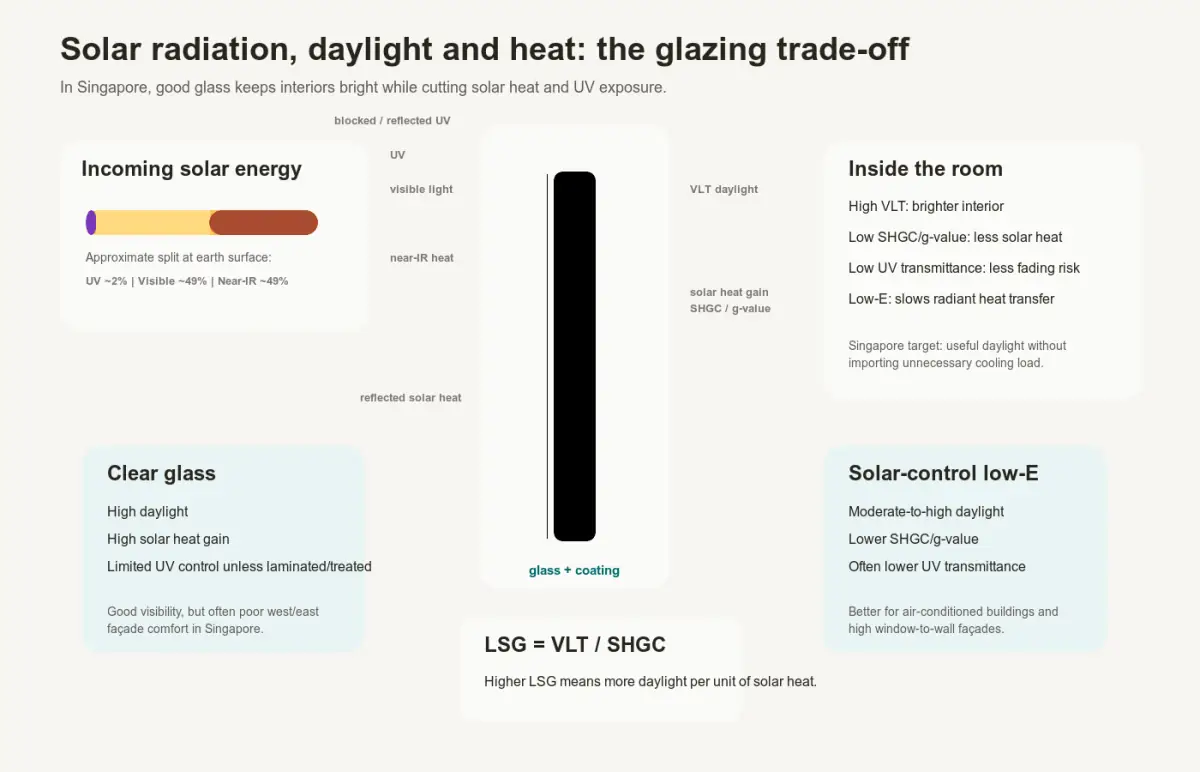
How glass protects against solar radiation
SEO summary: Solar-control glass in Singapore helps reduce solar heat gain, UV exposure and glare while maintaining daylight, improving comfort and supporting envelope-performance targets such as ETTV, RETV and SCglass.
Solar radiation reaches glass as visible light, infrared heat and ultraviolet radiation. A plain clear glass pane allows a high level of daylight, but it can also allow heat and UV exposure into the room. Solar-control glass is designed to manage that balance.
Visible light transmittance, usually called VLT, tells you how bright the room may feel. A high VLT gives more daylight and a clearer view. A very low VLT may reduce glare, but it can also make interiors darker and increase reliance on artificial lighting.
Solar heat gain coefficient, often called SHGC or g-value, tells you how much solar heat enters through the glass. Lower SHGC usually means better heat reduction. In Singapore, this matters because afternoon sun can quickly heat bedrooms, offices, lobbies and shopfronts.
UV reduction helps protect occupants, furniture, flooring, displays, curtains and interior finishes. Laminated glass interlayers and selected coatings can reduce UV transmission, but UV protection should be checked against the supplier’s tested performance data.
Radiant heat control is where low-E coatings are useful. Low-E coatings reduce long-wave heat transfer, and when combined with an IGU cavity, they can improve thermal performance. For solar-facing glass, the ideal specification often combines low SHGC, suitable VLT, acceptable external reflectance and practical maintenance requirements.
Choosing glass by customer problem
SEO summary: Select glass by the problem you need to solve: safety, heat reduction, glare control, UV protection, acoustic comfort, fire resistance, privacy, barrier compliance or façade performance.
| Customer problem | Better glass direction | Practical note |
|---|---|---|
| “The room is too hot.” | Solar-control glass, low-E glass, or solar-control IGU | Ask for SHGC, VLT and U-value, not just “tinted glass.” |
| “The afternoon glare is uncomfortable.” | Solar-control glass with suitable VLT | Too dark may reduce daylight too much. Balance glare and brightness. |
| “We need safer glass near people.” | Laminated safety glass or tempered laminated glass | Look for impact resistance and post-breakage retention. |
| “The glass is at a balcony or void edge.” | Laminated safety glass barrier system | The glass, fixing, handrail and support must work together. |
| “The external glass is high above ground.” | Laminated, heat-soaked tempered laminated, or protected systems | Review falling-fragment and spontaneous breakage risk. |
| “Noise is the problem.” | Laminated glass, thicker glass, asymmetric IGU or acoustic interlayer | Acoustic performance depends on the full build-up and frame. |
| “The door or wall needs fire rating.” | Tested fire-rated glass system | Ordinary safety glass is not a substitute for a fire-rated assembly. |
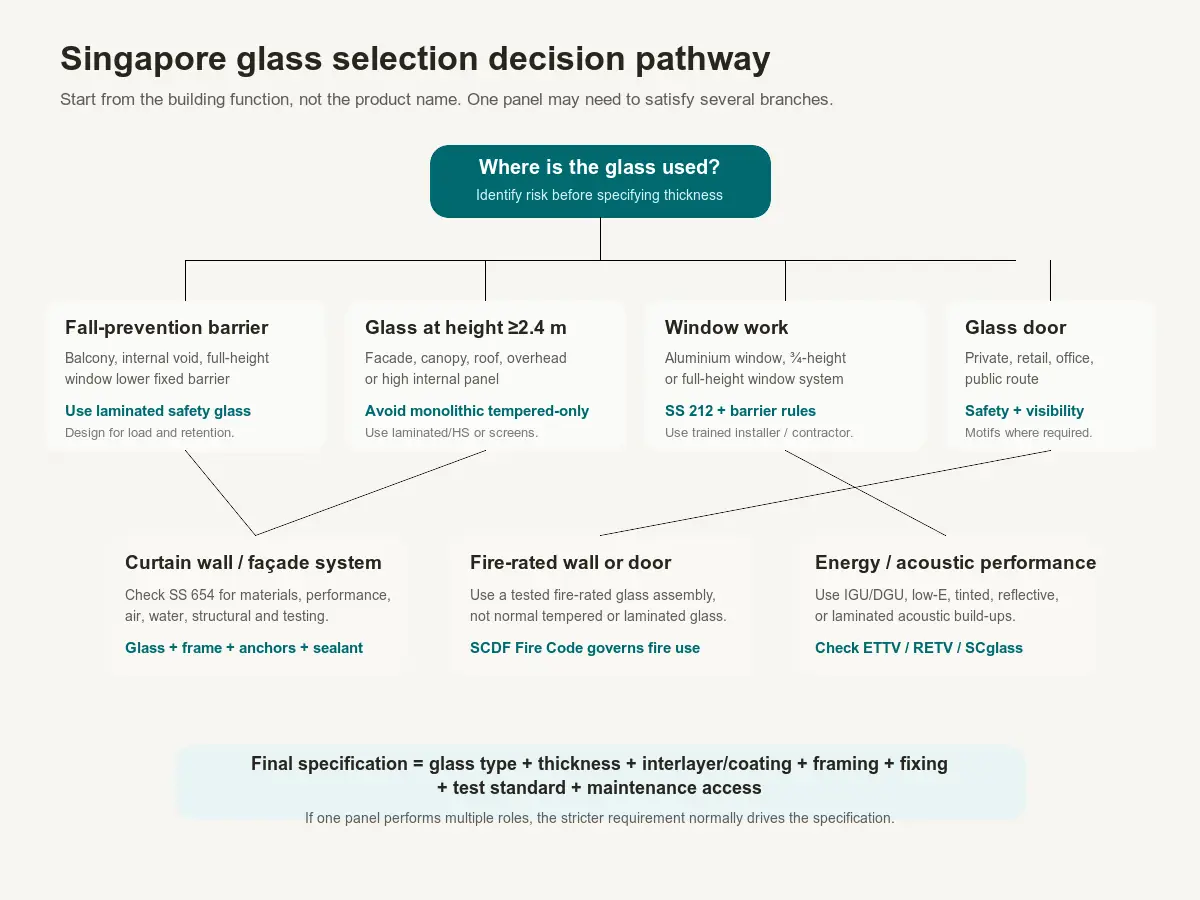
What Singapore project teams should check
SEO summary: For Singapore glass works, check BCA requirements, SS 341 safety glass, SS 653 safety glazing, SS 654 curtain walling, SS 212 windows, SCDF fire requirements and envelope-performance guidance before confirming the final glass specification.
For glass barriers, BCA’s Approved Document requires glass used as a barrier to be designed against loading and shattering risk, and the acceptable solution for glass barriers refers to laminated glass and SS 341 compliance.
For glass at height, the design should consider spontaneous breakage and falling fragments. This is especially important for façades, canopies, roofs, overhead glazing and panels above public areas.
For aluminium windows, SS 212 is relevant to window system performance. Where a window or fixed panel also functions as a safety barrier, barrier and safety-glazing requirements still need to be checked.
For public glass doors and full-height glazing, visibility matters. Manifestation or contrasting motif bands help people notice the glass before impact.
For fire-rated glass, the glass alone is not the fire rating. The tested assembly includes the glass, framing, beads, seals, ironmongery and installation details.
Simple specification checklist
SEO summary: A strong glass specification should state the glass type, thickness, interlayer, coating, cavity, safety requirement, barrier role, fire rating, acoustic target, solar performance and applicable Singapore standards.
Before requesting quotations, prepare a short specification checklist:
- State the location: window, façade, railing, door, partition, canopy, roof or shopfront.
- State the risk: fall prevention, impact, fire, heat, glare, acoustic, privacy or security.
- State the glass build-up: monolithic, laminated, IGU/DGU, laminated IGU, low-E, tinted or fire-rated system.
- State performance values where needed: VLT, SHGC, U-value, UV reduction, acoustic rating and fire rating.
- State whether the glass acts as a barrier or is installed at height.
- Ask for test certificates, compliance declarations and installation method statements.
- Confirm framing, fixings, gaskets, sealants, drainage and maintenance access.
Key standards and authorities checked
This article is intentionally written for customers, so the reference list is kept short. The detailed project specification should still be checked by the QP, PE, façade consultant, fire engineer and supplier.
- BCA Approved Document, including barrier and glass safety provisions: <https://www1.bca.gov.sg/docs/default-source/docs-corp-regulatory/building-control/approveddocument.pdf>
- BCA environmental sustainability circular covering envelope-performance direction including ETTV, RETV and SCglass: <https://www1.bca.gov.sg/docs/default-source/docs-corp-news-and-publications/circulars/bca-appbca-2021-16.pdf>
- SCDF Fire Code, including fire-rated glass and fire door assembly requirements: <https://www.scdf.gov.sg/firecode/table-of-content/chapter-3-structural-fire-precautions/clause-3.15>
- Singapore Standards previews for SS 341, SS 653, SS 654 and SS 212 should be checked for the latest project-specific clauses before final specification.
Need help choosing the right glass?
The safest way to choose glass is to start with the real use case, not the product name. Tell your supplier or consultant where the glass is installed, what risk it manages, whether people can fall against it, whether it is exposed to sun, whether it needs a fire rating and whether it is above public areas.
If you are comparing quotations, ask each supplier to state the exact glass build-up, thickness, interlayer, coating, cavity, tested performance and relevant compliance documents. This makes the quotation easier to compare and reduces the risk of choosing a glass that looks similar but performs differently.
Ready to request a quotation? Send your drawings, photos or site measurements and ask for a glass proposal that states the exact build-up, safety basis, solar performance and installation assumptions. If you already have quotations, compare them side by side before committing so you know whether each supplier is offering the same level of glass performance.