Engineering · Materials
Cat Ladder Materials: Aluminium vs SS304 vs Galvanised Mild Steel
Choosing the right cat ladder material for Singapore buildings — aluminium 6061-T6 / 6063-T6, stainless SS304 and galvanised mild steel compared on strength, corrosion, weight and cost.
· By Ezzogenics
Why this blog matters
A "cat ladder" is the industry term for a fixed vertical ladder — the kind found on roof access points, water tanks, plant decks, mezzanines, telecom shelters, and SCDF-mandated rescue hatches in storey shelters. It looks simple: two stiles, a row of rungs, a few wall brackets. But it is a life-safety component: a person at the top of a 6 m run can be carrying 100 kg of body + tools, and the ladder must stay rigid even after a slip-fall arrest event.
Three materials dominate the market in Singapore:
- Aluminium (typically alloy 6061-T6 or 6063-T6) — light, corrosion-resistant, premium price.
- Stainless Steel SS304 — strong, corrosion-resistant, medium-heavy weight, premium price.
- Galvanised Mild Steel — usually a S235 / S275 / S355 structural section, hot-dip galvanised to BS EN ISO 1461. Lowest material cost, heaviest, requires re-coating long-term.
This blog walks through the structural strength differences that drive the choice, with reference to BS EN ISO 14122-4 (the EN ladder design code), SS 570 (Singapore PPE/fall-protection standard), and SCDF storey-shelter cat-ladder requirements.
1. The design loads every cat ladder must meet
The starting point for any selection is what the ladder must carry. Per BS EN ISO 14122-4:2016 (Safety of machinery — Permanent means of access — Part 4: Fixed ladders):
| Load case | Magnitude | Where applied |
|---|---|---|
| Rung load F1 (one person) | 1.5 kN | Mid-rung, distributed over 100 mm |
| Stile load F2 (one person) | 1.5 kN | Each stile, 2 m apart |
| Fall-arrester anchor load | ≥ 6 kN | Top anchor, when device activates |
| Each anchorage point to wall | ≥ 3 kN per stile (two-stile ladder) | Each of four anchor points |
| Single-stile ladder | ≥ 6 kN | Through the single stile |
For comparison, OSHA 29 CFR 1910.23 requires every fixed ladder to support ≥ 250 lb (≈ 1.13 kN) on any two consecutive rungs simultaneously (OSHA fixed ladder requirements).
In Singapore, SCDF Technical Requirements for Storey Shelters 2021, Clause 2.11.2 mandates that "the cat-ladder shall be made of either stainless steel or aluminium or equivalent", and "the mounting connections of cat-ladder to the SS wall shall be designed to withstand shock loads of at least 12.5 g in all directions" (SCDF). For an 80 kg cat ladder, 12.5 g translates to a 10 kN shock load in each direction — a very onerous requirement that filters out flimsy materials immediately.
Takeaway: SCDF actively excludes mild steel for shelter cat ladders. For non-shelter applications (factory roof access, water tanks, plant rooms), all three materials are permitted, but EN 14122-4 is the load benchmark the designer must satisfy regardless of material.
2. Material strength compared
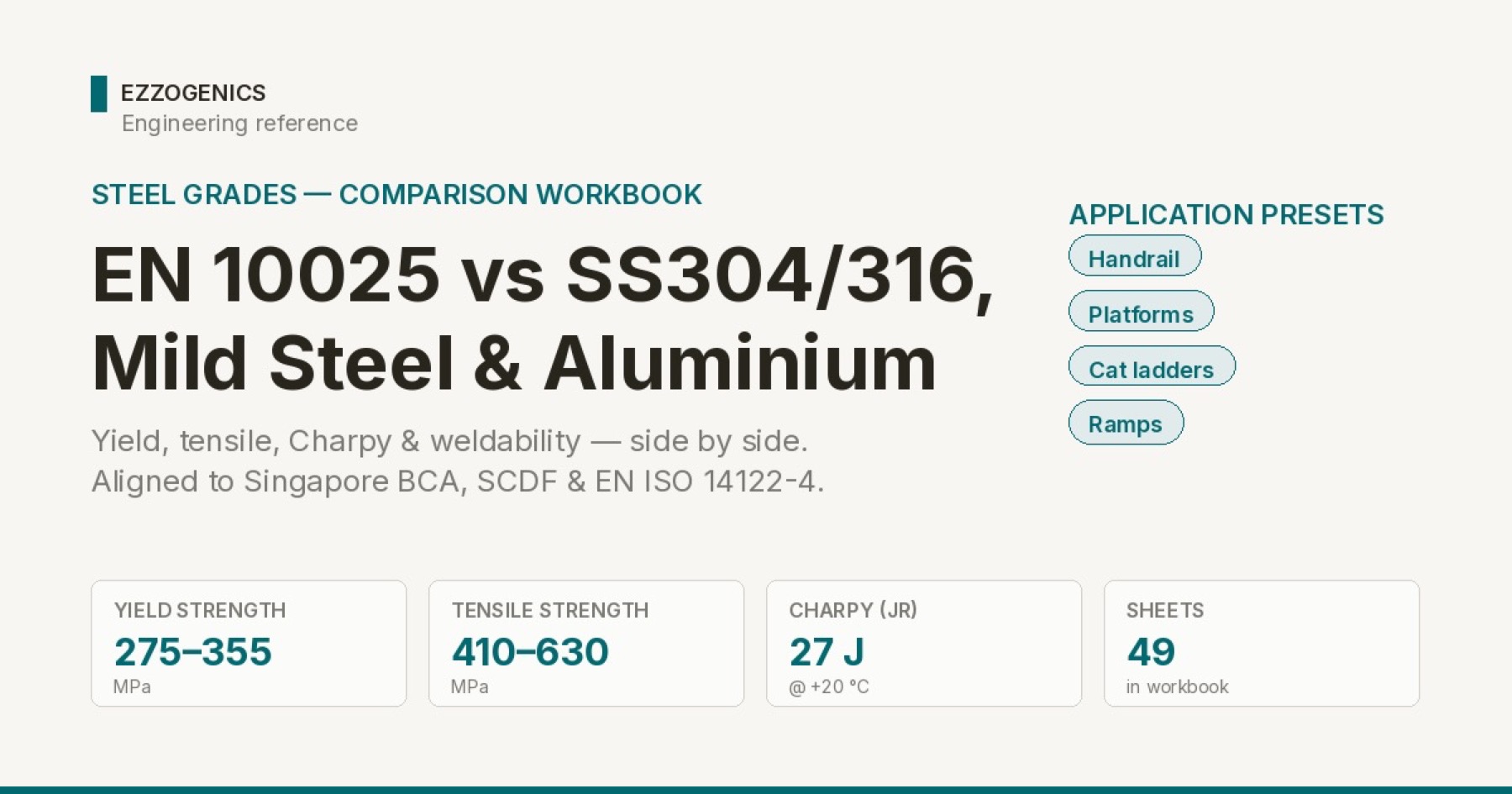
Drawing on data from the Cross-Material Strength and Strength-to-Weight sheets in the workbook, plus ASTM/EN handbook values:
| Property | Galv MS (S275) | Galv MS (S355) | SS304 | Aluminium 6063-T6 | Aluminium 6061-T6 |
|---|---|---|---|---|---|
| Yield strength fy | 275 MPa | 355 MPa | 210 MPa | 214 MPa | 276 MPa |
| Ultimate tensile strength | 410–560 MPa | 470–630 MPa | 515–720 MPa | 241 MPa | 310 MPa |
| Density ρ | 7,850 kg/m³ | 7,850 kg/m³ | 8,000 kg/m³ | 2,700 kg/m³ | 2,700 kg/m³ |
| Modulus of elasticity E | 210 GPa | 210 GPa | 200 GPa | 69 GPa | 69 GPa |
| Strength-to-weight (fy/ρ) | 35 kN·m/kg | 45 kN·m/kg | 26 kN·m/kg | 79 kN·m/kg | 102 kN·m/kg |
| EN partial factor γM0 | 1.00 | 1.00 | 1.10 (EN 1993-1-4) | 1.10 (EN 1999) | 1.10 (EN 1999) |
| Elongation at break | 22–26% | 22% | 45% | 12% | 12% |
Sources: workbook Cross-Material Strength sheet, Kloeckner 6061 vs 6063, AMD Supply.
What this means for ladder design
(a) Stiffness — not strength — usually governs cat ladder design. A cat ladder is a long slender column subject to load away from the wall. Deflection and lateral stability govern far more than yield. Aluminium has only one-third the stiffness of steel (E = 69 GPa vs 210 GPa). So although 6061-T6 has yield strength comparable to S275 mild steel, an aluminium stile must be deeper or thicker to match the same deflection limit. EN ISO 14122-4 implicitly recognises this: most aluminium ladders use thicker box-section stiles (e.g. 50×50×4 mm hollow) instead of the typical 50×10 mm flat stile used for steel.
(b) Stainless SS304 has lower yield, higher elongation, and a 10% strength penalty. SS304 yields at 210 MPa, slightly below even S235 mild steel. It also carries a higher partial factor (γM0 = 1.10 per EN 1993-1-4 vs 1.00 for carbon steel per EN 1993-1-1) — meaning the designer must reduce its capacity by another ~10% in calculations. To compensate, SS304 ladders are usually fabricated from slightly thicker stiles than mild-steel equivalents. The pay-off is 45% elongation (more than double mild steel's 22–26%), which gives SS304 superb energy absorption during a fall-arrest event.
(c) Galvanised mild steel has the best raw strength — when uncorroded. S275 galvanised is the workhorse material for industrial cat ladders. Yield is high, stiffness is high, and the section can be slim. The catch is corrosion: once the galvanising is breached the underlying steel rusts rapidly, and section loss erodes capacity. For an outdoor ladder in Singapore (humid, rain, salt-laden coastal air), a typical 80 µm hot-dip galvanising lasts 15–25 years in C3 environments, but only 5–10 years in C5-M coastal/industrial zones (BS EN ISO 14713-1).
3. Worked example — a 4 m roof access cat ladder
Let's apply EN ISO 14122-4 loads to a typical 4 m rise, 400 mm rung width, 4-bracket fixing ladder, and see what stile section each material needs.
Design action on each stile (worst case, person at mid-height):
- F2 = 1.5 kN per stile, applied 2 m apart → bending moment in stile ≈ 0.75 kN·m
- Plus self-weight bending and a 1.0 kN service torque from a slip event (typical assumption)
- Total design moment MEd ≈ 1.0 kN·m
Required plastic section modulus Wpl,Rd:
\[ W_{pl,Rd} \geq \frac{M_{Ed} \cdot \gamma_{M0}}{f_y} \]
| Material | fy | γM0 | Required Wpl | Typical stile section |
|---|---|---|---|---|
| Galv MS S275 | 275 MPa | 1.00 | 3.6 cm³ | 40 × 8 mm flat (Wpl = 3.2 cm³) — slightly under, use 50×8 (Wpl = 5.0 cm³) |
| SS304 | 210 MPa | 1.10 | 5.2 cm³ | 50 × 10 mm flat (Wpl = 6.25 cm³) ✓ |
| Al 6061-T6 | 276 MPa | 1.10 | 4.0 cm³ | 50 × 50 × 4 mm SHS (Wpl = 5.4 cm³) ✓ — but check deflection |
| Al 6063-T6 | 214 MPa | 1.10 | 5.1 cm³ | 60 × 60 × 4 mm SHS (Wpl = 7.4 cm³) ✓ |
Now the interesting part — deflection under F2 = 1.5 kN at mid-stile, simply supported between brackets at 1.5 m centres:
\[ \delta = \frac{F L^3}{48 E I} \]
For the same stile sections above:
| Material | I (cm⁴) | E (GPa) | δ at 1.5 kN over L = 1.5 m |
|---|---|---|---|
| MS S275, 50×8 flat | 8.3 | 210 | 0.5 mm |
| SS304, 50×10 flat | 10.4 | 200 | 0.6 mm |
| Al 6061-T6, 50×50×4 SHS | 22.0 | 69 | 0.7 mm |
The aluminium SHS is the bulkiest section but achieves comparable deflection because of its larger second moment of area I — the engineer trades section depth for the lower modulus.
This is exactly why aluminium cat ladders look chunkier than steel ones for the same span — and why a "spindly" aluminium ladder is a red flag for under-design.
4. Suitability summary — when to pick each material
| Application | Best choice | Why |
|---|---|---|
| SCDF storey-shelter rescue hatch | SS304 or Aluminium (mandated) | Mild steel not permitted; 12.5 g shock requirement |
| Indoor plant room, dry environment | Galv MS | Lowest material cost, longest life when dry, easy to weld and modify |
| Coastal / marine roof access | SS316 preferred, SS304 acceptable | Galv life < 10 years; aluminium pits in chloride splash |
| Petrochemical / industrial C5 zone | SS316 | Galv corrodes; SS304 risks pitting from chlorides + chemicals |
| Lightweight rooftop ladder, low load | Aluminium 6061-T6 | Easy to install single-handed; no painting; rust-free |
| Heavy industrial cat ladder, frequent traffic | Galv MS S355 | Highest stiffness, lowest cost, easy to inspect and repair |
| Food / pharma plant | SS304/SS316 | Hygienic, no flaking paint, easy to clean |
5. Compliance snapshot — what to specify on the drawing
Whichever material you pick, the drawing should call up:
- Geometry: Rung spacing 225–300 mm constant (EN 14122-4 §5.2.2.2). Clear width ≥ 150 mm and ≤ 250 mm between stile and slip-protection (§5.2.2.3). Tread surface ≥ 20 mm flat (§5.2.2.4).
- Clearance: ≥ 650 mm in front of rungs, ≥ 200 mm behind (EN 14122-4 §4.4). 7-inch (≈ 178 mm) minimum behind for OSHA-aligned design.
- Fall protection (above 3 m climbing height per EN 14122-4 §4.4.2.2, or 24 ft per OSHA 1910.28): cage or ladder safety system or personal fall arrest. For new ladders > 24 ft (7.3 m), most modern standards now require a rail-based safety system rather than a cage (OSHA 2017 update).
- Single-flight max length: 6 m without a rest platform; rest platform required at ≥ 12 m with fall arrester, ≥ 24 m without (KRAUSE EN 14122-4 guide).
- Material grade + finish:
- Galv MS: "S275JR to BS EN 10025-2, hot-dip galvanised to BS EN ISO 1461, minimum coating 85 µm"
- SS304: "1.4301 to BS EN 10088-2, polished to 240-grit, all welds passivated"
- Aluminium: "6061-T6 or 6063-T6 to BS EN 573-3, anodised 25 µm minimum"
- Anchorage design: each anchor ≥ 3 kN (or ≥ 6 kN single-stile); shock 12.5 g if SCDF storey-shelter.
- Welding: SS304 use 308L/308LSi filler, avoid sensitisation 425–850 °C (workbook Weldability sheet). MS: E7018 or equivalent. Aluminium: 4043 or 5356 filler depending on alloy.
6. Cost reality (Singapore market, indicative 2024–2026)
For a typical 4 m, 2-stile cat ladder with 4 wall brackets, no cage, fabricated and installed:
| Material | Indicative cost | Service life (Singapore tropical) |
|---|---|---|
| Galv MS S275 | S$ 350–500 | 15–25 years inland; 5–10 years coastal |
| SS304 | S$ 1,200–1,800 | 25+ years inland; 15–20 years coastal |
| SS316 | S$ 1,600–2,400 | 30+ years coastal; 50+ inland |
| Aluminium 6061-T6 | S$ 1,000–1,500 | 30+ years (no rust, anodising lasts) |
When you divide cost by service life, SS304 and aluminium often beat galvanised mild steel for outdoor coastal applications. For dry indoor plant access, galv MS remains the most cost-effective.
7. Bottom line
- For sheer strength-per-millimetre, S355 galvanised mild steel still wins — but durability is the limiting factor in Singapore's climate.
- SS304 is the best all-round structural choice, especially for life-safety installations where the ladder must remain trustworthy for decades.
- Aluminium is the lightest and most corrosion-immune option, but the lower stiffness (E = 69 GPa) forces designers to use thicker stiles — a "skinny" aluminium ladder is almost certainly under-designed.
- SCDF mandates SS or aluminium for storey-shelter cat ladders, with a 12.5 g shock-load anchorage check that is far more onerous than the EN 14122-4 baseline.
- Whatever material you pick, specify to BS EN ISO 14122-4 for geometry and loads, and call up the matching coating standard.
The next blog in this series covers how the ladder is anchored to the wall — concrete vs AAC vs cement block — and the engineering details that prevent the most common failure mode: anchor pull-out.
References cited inline. Workbook source: EN10025_Steel_Grades_Comparison.xlsx (Cross-Material Strength, Strength-to-Weight, Design Standards, Weldability sheets).