Steel · Reference
EN 10025 Steel Grades Comparison Singapore
How EN 10025 structural steel grades S235 to S500 compare on yield strength, tensile strength, weldability and design-standard treatment — with cross-references to stainless steel and aluminium for Singapore projects.
· By Ezzogenics
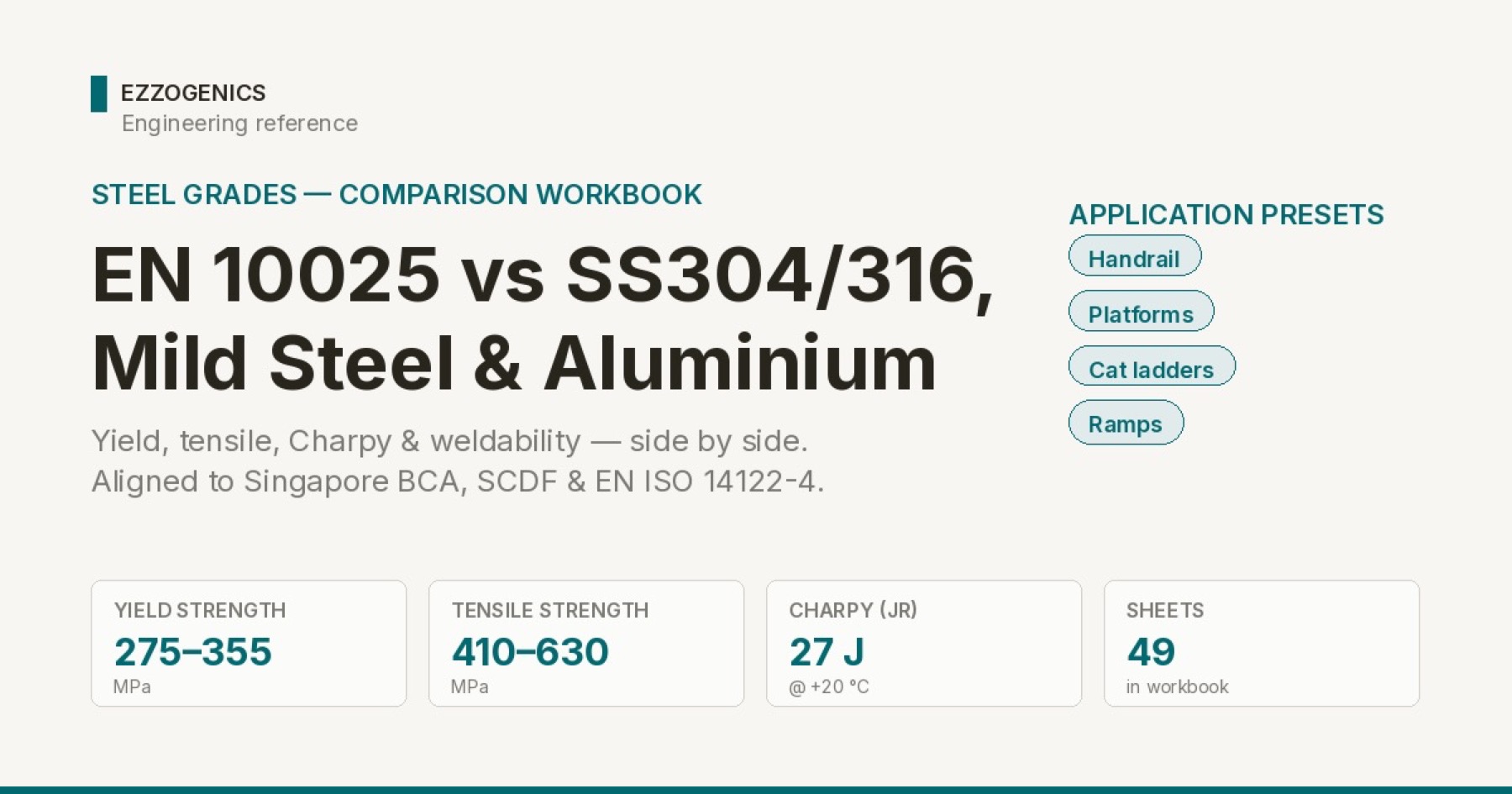
S235, S275, S355, S420, S460 and S500 Compared
EN 10025 covers six headline structural steel grades, named for their nominal yield strength in MPa at thickness ≤16 mm. Each grade has multiple sub-grades (JR, J0, J2, K2, M/N, ML/NL, Q, QL, QL1) that differ on Charpy impact toughness rather than strength. The grades, the part of EN 10025 that defines them, and their typical applications:
| Grade | Standard part | Yield (≤16mm) | Tensile range (≤16mm) | Typical use |
|---|---|---|---|---|
| S235 | EN 10025-2 | 235 MPa | 360–510 MPa | General construction, light frames, secondary structures |
| S275 | EN 10025-2 | 275 MPa | 410–560 MPa | Buildings, bridges, light structural frames |
| S355 | EN 10025-2 | 355 MPa | 470–630 MPa | High-rise, heavy bridges, offshore, wind turbines |
| S420 | EN 10025-2 / -3 / -4 | 420 MPa | 520–680 MPa | Plate girders, heavy bridges, columns |
| S460 | EN 10025-2 / -3 / -4 / -6 | 460 MPa | 540–720 MPa | Offshore, long-span bridges, cranes |
| S500 | EN 10025-4 / -6 | 500 MPa | 590–770 MPa | Mining machinery, offshore platforms, crane booms |
For Singapore work, S275JR and S355JR cover the great majority of fabrication. S235 is increasingly substituted by S275 because the price gap is small. S420 and above tend to appear on heavy civil and offshore projects.
Yield Strength and Tensile Strength by Thickness
Yield strength drops with increasing plate or section thickness. The numbers below are minimum ReH values per EN 10025-2/-3/-4/-6 Table 7:
| Thickness band | S235 | S275 | S355 | S420 | S460 | S500 |
|---|---|---|---|---|---|---|
| ≤16 mm | 235 | 275 | 355 | 420 | 460 | 500 |
| >16–40 mm | 225 | 265 | 345 | 400 | 440 | 480 |
| >40–63 mm | 215 | 255 | 335 | 390 | 430 | 440 |
| >63–80 mm | 215 | 245 | 325 | 370 | 410 | N/A |
| >80–100 mm | 215 | 235 | 315 | 360 | 400 | N/A |
| >100–150 mm | 195 | 225 | 295 | 340 | 380 | N/A |
Tensile strength Rm is given as a min–max range. At ≤16 mm, S275 sits at 410–560 MPa, S355 at 470–630 MPa, and S460 at 540–720 MPa. The full thickness-banded tables and additional ranges are in the EN steel supplement.
Cross-Material Comparison: Carbon Steel, Stainless Steel and Aluminium
EN 10025 does not stand alone — most Singapore projects compare it against EN 10088 stainless steels and EN 573-3 aluminium alloys. The headline differences:
| Material family | Example grade | Yield / Rp0.2 | E (GPa) | Density (kg/m³) | Design code |
|---|---|---|---|---|---|
| Carbon steel | S275JR | 275 MPa | 210 | 7,850 | EC3 EN 1993-1-1 |
| Carbon steel | S355JR | 355 MPa | 210 | 7,850 | EC3 EN 1993-1-1 |
| Stainless steel | SS304 (1.4301) | 210 MPa Rp0.2 | 200 | 7,900 | EC3 EN 1993-1-4 |
| Stainless steel | SS316 (1.4401) | 220 MPa Rp0.2 | 200 | 7,980 | EC3 EN 1993-1-4 |
| Stainless steel | 2205 Duplex | 450 MPa Rp0.2 | 200 | 7,800 | EC3 EN 1993-1-4 |
| Aluminium | 6082-T6 plate ≤12.5 mm | 255 MPa | 70 | 2,700 | EC9 EN 1999-1-1 |
| Aluminium | 6061-T6 | 276 MPa | 69 | 2,700 | EC9 EN 1999-1-1 |
| Aluminium | 5083-H111 (marine) | 125 MPa | 70 | 2,660 | EC9 EN 1999-1-1 |
Two design subtleties matter here:
- Partial safety factor. Carbon steel uses γM0 = 1.00; stainless and aluminium use γM0 = 1.10. So a stainless section needs to be roughly 25% bigger than the carbon steel equivalent to deliver the same design strength.
- Heat-affected zone (HAZ). Aluminium loses around 50% of proof strength locally at welds, and EC9 §6.1.6 requires a
ρhazfactor in design. Carbon steel and austenitic stainless do not need this reduction.
Weldability, Design Standards and Cost Checks
Carbon equivalent value (CEV) drives the welding rule book. The maximum CEV permitted by EN 10025 climbs with grade:
| Grade | CEV max | Weldability | Preheat indication (t > 25 mm) | PWHT |
|---|---|---|---|---|
| S235 | 0.35 | Excellent | None / slight | Not required |
| S275 | 0.40 | Excellent | ~100°C | Not required |
| S355 | 0.45 | Good | 100–150°C | Not required |
| S420 | 0.47 | Good | 150°C | Consult spec |
| S460 | 0.53 | Moderate | 150–200°C | Sometimes |
| S500 | 0.56 | Moderate | 200°C | Sometimes |
Final preheat and PWHT requirements should be checked against project requirements by the welding engineer or QP where required. CEV alone does not capture every welding consideration — section thickness, hydrogen control and ambient conditions matter too.
On cost, the EN steel supplement carries indicative material prices and a cost-per-MPa-yield ratio. As a rough guide for Singapore fabrication budgets:
- Mild steel S275 sets the cost baseline (1×).
- Galvanised mild steel adds roughly 25–30% for the zinc coat.
- SS304 sits at roughly 3× per kg, but design-strength is lower so the practical cost-per-MPa is closer to ~3×.
- SS316L is around 4× per kg.
- Aluminium 6061/6082 sits at roughly 2.3× per kg, with much lower density so per-metre weight is lower.
Download the Steel Comparison Workbook
Our EN Steel Comparison Technical Supplement carries the full set of tables — yield, tensile, weldability, cross-material, weight, cost and platform load — plus a downloadable Excel workbook with the same data, anchor-bolt cross-references and integrated calculators. The supplement is the canonical source for the numbers summarised on this page.