Materials · Handrails
SS304 vs Mild Steel Handrails in Singapore
A comparative look at austenitic stainless steel SS304 and structural mild steel grades S235JR / S275JR for handrail design in Singapore — strength, corrosion, code-compliance and cost trade-offs.
· By Ezzogenics
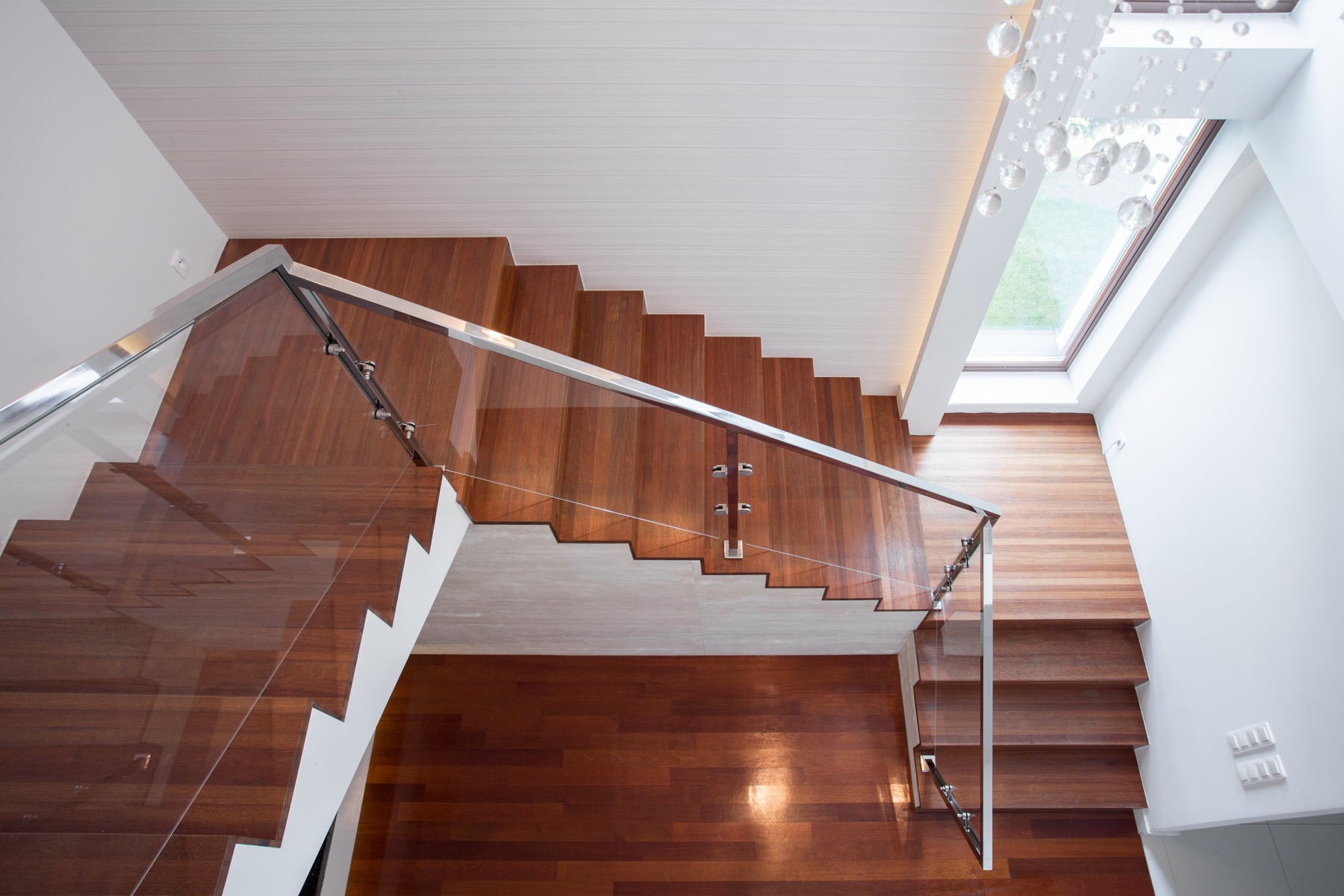
What the EN10025 workbook tells us about choosing between austenitic stainless and structural carbon steel for handrails
When a handrail is being specified — whether for a stair flight, a balcony, a walkway around plant equipment, or an architectural balustrade — the choice between stainless steel SS304 and a mild steel grade (typically S235JR or S275JR) is rarely about strength alone. It's a balance of mechanical performance, code-compliance, corrosion exposure, weldability, fabrication cost, and long-term maintenance.
The EN10025_Steel_Grades_Comparison workbook computes that balance side-by-side. This post walks through what the comparison actually contains and how it informs handrail selection.
The mechanical numbers, side by side
The workbook's Cross-Material Strength sheet tabulates the headline mechanical properties for both materials at the reference thickness most relevant to handrail tube walls (≤16 mm):
| Property | Mild Steel S235JR | Mild Steel S275JR | Stainless Steel SS304 (1.4301) |
|---|---|---|---|
| Yield / 0.2% proof strength | 235 MPa (sharp yield ReH) | 275 MPa (sharp yield ReH) | 210 MPa (Rp0.2 — no defined yield point) |
| Tensile strength Rm (min–max) | 360–510 MPa | 410–560 MPa | 520–720 MPa |
| Elongation at fracture A | 26% | 23% | 45% |
| Young's modulus E | 210 GPa | 210 GPa | 200 GPa |
| Density | 7,850 kg/m³ | 7,850 kg/m³ | 7,900 kg/m³ |
| Design code | EC3 EN 1993-1-1 | EC3 EN 1993-1-1 | EC3 EN 1993-1-4 |
| Partial safety factor γM0 | 1.00 | 1.00 | 1.10 |
| Corrosion resistance | Poor (paint or galv required) | Poor (paint or galv required) | Excellent (rural/urban) |
A surprise emerges immediately: on yield strength alone, SS304 (210 MPa) is actually below S235JR (235 MPa) and well below S275JR (275 MPa). Stainless steel does not win the strength contest — austenitic grades are softer at yield because they have no sharp yield point. They make up for it with much higher tensile strength (Rm) and dramatically higher ductility (45% elongation versus 23–26%).
What the workbook calculates that matters for handrails
1. Effective design strength (after partial safety factors)
The Design Standards sheet captures the critical Eurocode detail that's often overlooked: stainless and mild steel use different partial safety factors.
- Mild steel: design yield = ReH ÷ γM0 = 235 ÷ 1.00 = 235 MPa (S235) or 275 MPa (S275)
- Stainless SS304: design yield = Rp0.2 ÷ γM0 = 210 ÷ 1.10 = 191 MPa
The penalty is real: SS304 has roughly 65% of the design strength of S275 at the same wall thickness. The workbook's Design Standards sheet flags this directly: "Section ~25% larger than carbon steel equivalent (lower design strength)" for stainless.
2. Specific strength (strength-to-weight)
The Strength-to-Weight sheet computes specific strength as yield ÷ density × 1000:
- S235: 29.9 MPa·m³/kg
- S275: 35.0 MPa·m³/kg
- SS304: 26.6 MPa·m³/kg
- SS316: 27.6 MPa·m³/kg
Mild steel wins for pure structural efficiency. Stainless is heavier per unit of strength delivered — which means a stainless handrail needs a slightly thicker wall (or larger section) than the equivalent mild steel one to carry the same code-prescribed handrail load (typically 0.74 kN/m line load horizontal, plus a 1.5 kN point load per most building regulations).
3. Code compliance for handrail loads
Handrail design loading is governed by occupancy. For a typical 1.0 m high commercial handrail loaded with a 0.74 kN/m line load applied at the top rail, both materials pass comfortably for tube walls of 1.5–2.0 mm. The workbook's section catalogues bear this out:
- TSA SS304 round tube (SS Round Tube sheet): 25.4 mm OD × 1.5 mm wall is a standard handrail size, available in 6 m lengths
- JYF mild steel CHS (MS Carbon Pipe sheet): closest equivalent is 25 mm nominal × 3.2 mm wall — noticeably heavier (2.43 kg/m vs roughly 0.9 kg/m for the stainless)
The bigger wall on mild steel is a corrosion allowance, not a strength requirement — paint and galv don't last forever, and pipes are sized to retain capacity even after some sacrificial loss.
4. Weldability and fabrication
The Weldability sheet captures the fabrication side:
| Aspect | S235 / S275 | SS304 |
|---|---|---|
| Weldability rating | Excellent | Excellent (austenitic) |
| Carbon equivalent CEV (max) | 0.35 (S235) / 0.40 (S275) | n/a (austenitic) |
| Preheat (t ≤ 25 mm) | None required | None required |
| Filler metal | E7018 / G3Si1 | 308L or 308LSi |
| Key risk | None significant in handrail thickness | Sensitisation (Cr-carbide precipitation 425–850°C) |
| Back-purging | Not required | Recommended for tube butt welds |
Both weld easily in handrail wall thicknesses. The practical fabrication difference is that stainless requires back-purging argon for tube butt welds (otherwise you get sugar/scale on the inside of the joint) and the welder needs to manage heat input to avoid sensitisation. Mild steel handrails can be MIG-welded with standard shop practice.
5. Surface finish — the architectural axis
This is where the workbook's catalogue data becomes important. The SS Catalogue (TSA) sheet lists six standard polish grades for SS304 tube:
- Grit 180 — coarse, industrial use
- Grit 240 — medium-fine, standard architectural
- Grit 320 — fine, decorative
- Grit 400, 600, 800 — successively finer for high-spec interior
Mild steel (JYF catalogue) has no equivalent finish ladder. It comes in plain hot-rolled or galvanised, and any architectural finish is a downstream coating: powder-coat, painted, or chrome-plated. The cost of achieving a comparable visual finish on mild steel often closes the price gap with stainless.
The suitability matrix the workbook drives
Combining these data points, a clear suitability picture emerges:
Choose SS304 when:
- Exposure includes humidity, condensation, splash, or atmospheric salt — coastal Singapore, swimming pools, food processing, hospitals, marinas
- Architectural visual finish matters — polished or brushed grain is a primary aesthetic
- Hand contact is frequent and a non-rusting tactile surface is required (most public handrails)
- Whole-life cost is a procurement criterion — the workbook's Design Standards sheet notes: life-cycle cost advantage: very low maintenance
- Maintenance access is difficult — repainting later would be expensive or disruptive
Choose mild steel S235/S275 when:
- Environment is dry and indoor, or the rail will be coated and inspected on a maintenance cycle
- Capital cost is the dominant constraint — mild steel is roughly 4–6× cheaper per tonne than stainless (per the workbook's Design Standards sheet: Relative material cost: low (baseline = 1×) vs high (~4–6× carbon steel by weight) for stainless)
- The rail will be hidden, painted, or part of an industrial fabric (plant rooms, machinery guarding, back-of-house stairs)
- Hot-dip galvanising is acceptable visually — galvanised mild steel is a perfectly serviceable handrail material in many semi-exposed contexts and can last 20–30 years before maintenance
A worked example: 1.0 m commercial stair handrail, 6 m run
Using the workbook's calculators with code line load 0.74 kN/m + 1.5 kN point load:
| Spec | SS304 option | Mild Steel option |
|---|---|---|
| Section | 38 × 1.5 mm round tube (TSA) | 32 mm nom × 3.2 mm carbon pipe (JYF) |
| Linear weight | ~1.4 kg/m | ~3.4 kg/m |
| Run weight (top rail only) | ~8.4 kg | ~20.4 kg |
| Surface treatment | Grit 320 polish (mill finish) | Hot-dip galvanised (post-fab) |
| Estimated supply rate (workbook Cost Estimator inputs) | SGD 9.50/kg | SGD 1.85/kg |
| Top rail material cost | ~SGD 80 | ~SGD 38 |
| Coating / finishing | Included | + galvanising (~SGD 1.50/kg = SGD 30) |
| Effective material + finish cost | ~SGD 80 | ~SGD 68 |
| 20-year maintenance | None expected | 1× recoat ~SGD 50 + access |
| 20-year total | ~SGD 80 | ~SGD 118+ |
The capital premium for SS304 is real but smaller than the headline material rate suggests once finishing is included, and stainless wins the lifecycle contest comfortably for any exposed handrail.
Summary
For handrail design, the workbook calculates a clear comparative picture:
- Strength: Mild steel S275 has the highest design yield (275 MPa). SS304 is the lowest (191 MPa after γM0 = 1.10). Both are more than adequate for handrail loads at standard wall thicknesses.
- Weight efficiency: Mild steel is ~30% better in specific strength terms.
- Ductility: SS304 wins decisively (45% elongation vs 23–26%) — better for impact-loaded rails.
- Corrosion suitability: SS304 is Excellent in the workbook's rating; mild steel needs paint or galv to be serviceable in any humid or exposed environment.
- Weldability: Both rated excellent for handrail-thickness sections.
- Cost: Mild steel is 4–6× cheaper per tonne raw, but the gap closes substantially after finishing and disappears over a 15–20 year lifecycle.
Practical takeaway: SS304 is the right answer for visible, exposed, or high-touch handrails — which is most of them in a tropical-coastal climate like Singapore. Mild steel is the right answer for hidden, industrial, or coated rails where capital cost is the governing constraint and a maintenance regime is in place.
The workbook lets either choice be sized, weighed, costed, and verified against the same Eurocode framework — that's the point of having both material families in one comparative tool.